

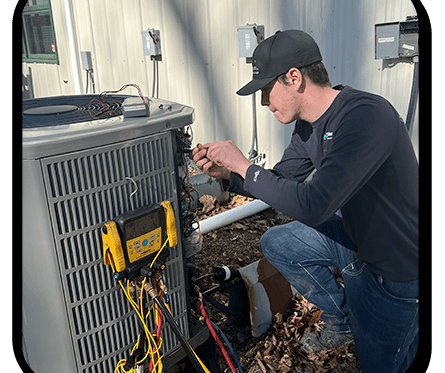
Heat pump replacement costs vary significantly based on system type, efficiency ratings, and installation requirements. Understanding these factors helps homeowners budget accurately and make informed decisions when replacing aging equipment. This guide provides national cost data from government agencies, industry associations, and consumer research to establish realistic replacement cost expectations.
What You’ll Learn in this Report
|
National Heat Pump Replacement Cost Ranges
Heat pump replacement projects involve equipment, labor, and installation materials. National averages provide baseline expectations, though regional labor rates and specific installation requirements create significant variation.
The table below shows typical replacement cost ranges by system type:
Consumer cost data aggregated by Forbes Home places typical residential heat pump replacements between $8,000 and $15,000 for central ducted systems, while the Bureau of Labor Statistics reports median HVAC mechanic wages of $26.03 per hour nationally, with installation labor typically accounting for 30 to 40 percent of total project cost.
Heat Pump Replacement Cost by Home Size
System capacity, measured in tons or BTUs, scales with conditioned space. Larger homes require larger equipment, longer refrigerant lines, and more installation labor.
Proper sizing requires a Manual J load calculation in accordance with ACCA standards. Oversized equipment cycles frequently and reduces efficiency. Undersized systems run continuously without maintaining comfort.
Understanding Efficiency Ratings: SEER2 and HSPF2
Heat pump efficiency ratings changed in 2023 from SEER/HSPF to SEER2/HSPF2, reflecting updated testing procedures that better represent real-world performance.
ENERGY STAR minimum requirements (effective 2023):
Higher efficiency ratings increase equipment cost but reduce operating expenses. A system rated at 18 SEER2 costs $1,500 to $3,000 more than a 15 SEER2 unit of the same capacity, according to aggregated consumer cost data. Energy savings offset the premium over the equipment’s 15- to 20-year service life.
The Air-Conditioning, Heating & Refrigeration Institute (AHRI) maintains performance standards through AHRI Standard 210/240, which governs how manufacturers test and rate residential heat pumps.
Main Cost Drivers
Several factors beyond equipment capacity affect final replacement cost. Understanding these helps homeowners interpret contractor estimates accurately.
Air-Source vs. Ductless vs. Geothermal Comparison
Three main heat pump categories serve residential applications. Each offers distinct advantages and cost structures.
Air-source ducted systems use existing ductwork to distribute conditioned air throughout the home. These represent the most common replacement scenario when central forced-air heating already exists. Installation costs remain lower than other options when ductwork requires minimal modification.
Ductless mini-split systems eliminate duct losses, which can reach 20 to 30% in poorly sealed duct systems, according to Department of Energy research. Each indoor unit serves a specific zone, providing room-by-room temperature control. Multi-zone systems serving whole homes cost more than ducted systems but offer superior efficiency and greater control over comfort.
Geothermal (ground-source) heat pumps extract or reject heat from stable ground temperatures rather than outdoor air. These systems achieve the highest efficiency ratings but require significant upfront investment for ground loop installation. Closed-loop systems circulate fluid through buried pipes, while open-loop systems use well water as the heat exchange medium.
Federal Tax Credits and Incentives
Energy Efficient Home Improvement Credit (25C):
The Inflation Reduction Act provides significant federal tax credits for qualifying heat pump installations, reducing net replacement cost.
The IRS Energy Efficient Home Improvement Credit offers tax credits for heat pump installations that meet the ENERGY STAR Most Efficient criteria. Eligible homeowners receive up to $2,000 in tax credits for qualifying air-source heat pumps installed through December 31, 2032.
Eligibility requirements:
Heat pumps must meet or exceed ENERGY STAR Most Efficient specifications. Installation must occur in the taxpayer’s existing primary residence. The credit applies to the combined equipment and installation costs.
How the credit works:
The credit equals 30 percent of the total project cost, up to a maximum of $2,000 for heat pumps. This credit is non-refundable, meaning it reduces tax liability but does not generate a refund beyond taxes owed. The credit can be claimed in the year of installation.
For a $12,000 heat pump replacement meeting efficiency requirements, the credit reduces the net cost to $10,000. For a $15,000 project, the maximum $2,000 credit applies, reducing the net cost to $13,000.
Additional state and utility rebates may stack with federal credits. Homeowners should check state energy offices and local utility programs for additional incentives.
Labor and Installation Components
Professional installation ensures proper refrigerant charge, electrical connections, and system startup. Installation labor represents 30 to 40 percent of total replacement cost according to industry standards.
Standard installation includes:
- Removal and disposal of old equipment.
- New outdoor unit placement and leveling.
- Indoor air handler or evaporator coil installation.
- Refrigerant line connection and pressure testing.
- Evacuation and refrigerant charging to manufacturer specifications.
- Electrical connections and safety testing.
- Condensate drain installation or modification.
- Thermostat installation and programming.
- System startup and performance verification.
Bureau of Labor Statistics data shows median HVAC mechanic wages of $26.03 per hour nationally, with experienced installers earning $35 to $45 per hour. Regional labor markets create significant variation. Metropolitan areas with a higher cost of living typically see installation labor rates 20 to 40 percent above the national median.
Cold Climate Considerations
Standard heat pumps lose heating capacity as outdoor temperatures drop. Below 35 degrees Fahrenheit, efficiency declines and supplemental heat may engage. Cold climate heat pumps use enhanced vapor injection and variable-speed compressors to maintain capacity down to minus 15 degrees Fahrenheit or lower.
Department of Energy research confirms modern cold climate heat pumps provide effective heating in northern climates previously considered unsuitable for heat pump technology. Consumer Reports testing validates performance claims, showing that qualified models maintain their rated capacity at temperatures well below freezing.
Cold climate models typically add $1,000 to $2,500 to equipment cost compared to standard efficiency units. The premium pays for enhanced compressor technology and improved heat exchangers that extract heat from colder air.
When Replacement Makes Sense
Heat pump replacement becomes necessary when repair costs approach 50 percent of replacement cost, and the unit has reached 12 to 15 years of service. The decision involves equipment age, repair frequency, efficiency decline, and refrigerant type.
Replacement indicators:
- The equipment age exceeds 12 to 15 years.
- Repair estimates exceed $2,500 to $3,000.
- The system uses R-22 refrigerant (phased out, expensive to service).
- Efficiency has declined noticeably, raising operating costs.
- Frequent repairs indicate multiple component failures.
Replacing aging equipment with high-efficiency models meeting current ENERGY STAR standards can reduce operating costs 30 to 40 percent, according to Department of Energy estimates. Federal tax credits further improve replacement economics.
Notes
Heat pump replacement costs reflect multiple variables, including system type, capacity, efficiency rating, and installation complexity. Federal tax credits significantly reduce the net cost for qualifying installations. Homeowners should obtain multiple estimates from licensed contractors following ACCA quality standards. Proper sizing using Manual J load calculation ensures equipment operates efficiently and maintains comfort. ENERGY STAR certification identifies equipment meeting minimum efficiency thresholds.
Sources
- U.S. Environmental Protection Agency – Section 608 Technician Certification – Federal refrigerant handling requirements
- ENERGY STAR – Air Source Heat Pumps Key Product Criteria – Efficiency requirements and federal tax credit eligibility
- Internal Revenue Service – Energy Efficient Home Improvement Credit – Federal tax credit amounts and eligibility requirements
- U.S. Bureau of Labor Statistics – Occupational Employment and Wages: Heating, Air Conditioning, and Refrigeration Mechanics and Installers – National labor cost data
- Air-Conditioning, Heating & Refrigeration Institute – AHRI Standard 210/240 – Industry performance rating standards
- Air Conditioning Contractors of America – Quality Standards – Installation quality standards and Manual J sizing requirements
- U.S. Department of Energy – Heat Pump Systems – Technical information and efficiency research


