

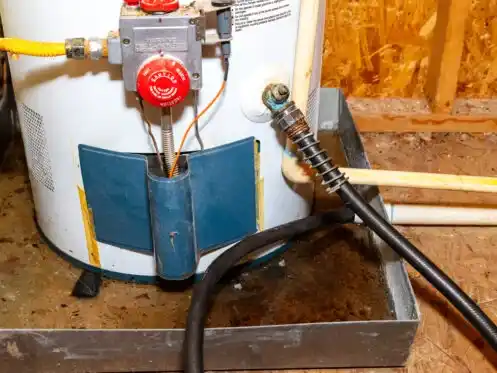
National water heater replacement costs in 2025 typically range from $900 to $3,500 for standard tank units, $1,200 to $5,500 for tankless systems, and $1,800 to $6,000 for heat pump water heaters. Total costs depend on unit type, capacity, fuel source, installation complexity, and regional labor rates, which commonly range from $45 to $150 per hour.
What You’ll Learn in this Report
|
National Average Replacement Cost
Installed totals include equipment, labor, basic venting modifications, permit fees where required, and standard disposal of the old unit.
| Water Heater Type | Typical Installed Cost Range |
|---|---|
| Tank (electric) | $900 to $2,000 |
| Tank (gas) | $1,200 to $2,500 |
| Tankless (electric) | $1,200 to $3,500 |
| Tankless (gas) | $2,000 to $5,500 |
| Heat pump (hybrid electric) | $1,800 to $6,000 |
| Solar water heater | $3,000 to $9,000 |
Interpretation note: Lower ends reflect straightforward replacements in accessible locations with standard venting; upper ends account for complex installations, structural modifications, electrical upgrades, or premium efficiency models.
Cost by Water Heater Type
Different technologies carry distinct installation requirements and upfront costs.
| Type | Equipment Cost | Installation Labor | Total Typical Range | Key Considerations |
|---|---|---|---|---|
| Electric tank | $400 to $1,200 | $500 to $800 | $900 to $2,000 | Simplest installation; widely available |
| Gas tank | $500 to $1,500 | $700 to $1,000 | $1,200 to $2,500 | Requires venting and gas line access |
| Electric tankless | $600 to $2,000 | $600 to $1,500 | $1,200 to $3,500 | May require electrical panel upgrade |
| Gas tankless | $1,000 to $3,500 | $1,000 to $2,000 | $2,000 to $5,500 | Requires a larger gas line and venting modifications |
| Heat pump | $1,200 to $3,500 | $600 to $2,500 | $1,800 to $6,000 | Highest efficiency; requires adequate ambient air volume |
Short note: Installation labor varies significantly based on whether the replacement is “like-for-like” or involves fuel type conversion, venting changes, or electrical service upgrades.
Cost by Capacity and Fuel Type
Tank water heater pricing by common residential capacities.
| Capacity | Electric (Installed) | Gas (Installed) |
|---|---|---|
| 30-gallon | $800 to $1,400 | $1,000 to $1,800 |
| 40-gallon | $900 to $1,600 | $1,100 to $2,000 |
| 50-gallon | $1,000 to $1,800 | $1,200 to $2,200 |
| 75-gallon | $1,400 to $2,500 | $1,800 to $3,000 |
| 80-gallon | $1,500 to $2,800 | $2,000 to $3,500 |
Tankless water heater pricing by flow rate.
| Flow Rate (GPM) | Electric (Installed) | Gas (Installed) |
|---|---|---|
| 2 to 3 GPM (point-of-use) | $300 to $800 | $800 to $1,500 |
| 5 to 7 GPM (1-2 bathrooms) | $1,200 to $2,500 | $2,000 to $3,500 |
| 8 to 10 GPM (whole-house) | $2,000 to $3,500 | $3,000 to $5,500 |
Practical note: Flow rate requirements depend on simultaneous usage patterns; cold climate installations may require higher GPM ratings to achieve the desired temperature rise.
Cost Factors That Affect Water Heater Replacement Pricing
Labor and Installation Breakdown
Standard installation timelines and labor cost components.
| Installation Component | Typical Cost/Time |
|---|---|
| Standard tank replacement (like-for-like) | 2 to 4 hours at $45 to $150/hour |
| Tankless installation (new) | 4 to 8 hours at $45 to $150/hour |
| Heat pump installation | 3 to 6 hours at $45 to $150/hour |
| Fuel conversion (electric to gas or reverse) | Adds 2 to 6 hours and $500 to $2,000 in materials |
| Venting modifications | $200 to $1,000, depending on configuration |
| Electrical panel upgrade | $500 to $2,000 for new circuits or panel expansion |
| Gas line extension or upsizing | $300 to $1,500, depending on distance and pipe diameter |
| Permit acquisition | $50 to $300, depending on jurisdiction |
Installation timing note: Straightforward tank-to-tank replacements are often complete in one day; tankless conversions and heat pump installations may require two days when electrical or structural work is needed.
Replacement vs Repair Decision Thresholds
Age, repair cost, and efficiency considerations guide replacement decisions.
| Decision Factor | Favor Repair | Favor Replacement |
|---|---|---|
| Age of unit | Less than 8 years | 10+ years (tank), 15+ years (tankless) |
| Repair cost vs replacement cost | Repair under 30% of the replacement cost | Repair exceeds 50% of replacement cost |
| Efficiency | Current unit meets needs | Energy Factor (EF) under 0.90 for tank, under 0.82 for tankless |
| Failure history | First significant repair | Multiple repairs in the past 2 years |
| Capacity match | Current capacity adequate | Household needs have changed |
Practical consideration: Units approaching 10 years (tank) or 15 years (tankless) with major component failures often prove more economical to replace due to improved efficiency and declining repair reliability.
Methodology
Cost ranges are compiled and normalized from consumer cost guides, contractor surveys, and manufacturer pricing for 2025. Bands reflect regional labor rate variation, urban versus rural markets, installation complexity tiers, and equipment quality levels. Installed totals assume a standard residential installation with basic venting, standard electrical connections, minimal structural modification, permit acquisition, and old-unit disposal. Complex installations involving fuel conversion, major electrical upgrades, structural changes, or specialty venting fall within the upper range or exceed it.
Sources
HomeAdvisor: Water Heater Installation Cost – National averages and installation factors
U.S. Department of Energy: Water Heating – Efficiency standards and technology overview
ENERGY STAR: Water Heaters – Efficiency ratings and qualified products
Notes
Cost bands are national planning ranges; actual quotes depend on brand selection, installation location accessibility, local labor rates, permit requirements, and scope of ancillary work (electrical upgrades, venting modifications, gas line work).
Regional variations: Coastal metro areas and high-cost urban markets trend 20 to 40 percent above national averages; rural markets and lower-cost regions trend 10 to 30 percent below.
Installation complexity: Like-for-like tank replacements represent the lower cost range; fuel conversions, major electrical upgrades, significant venting modifications, or structural changes approach or exceed upper range limits.
Energy efficiency: Higher-efficiency models (ENERGY STAR certified) carry premium equipment costs but reduce long-term operating expenses and may qualify for utility rebates or tax credits.
Always request itemized estimates separating equipment cost, labor hours and rate, materials (venting, electrical, gas line), permit fees, and disposal charges to enable accurate comparison.


